Writing a Place You Remember Without Filling the Gaps
Writing a place you remember can make a scene vivid without invented certainty: separate sensory details from guesses and shape the gaps honestly.
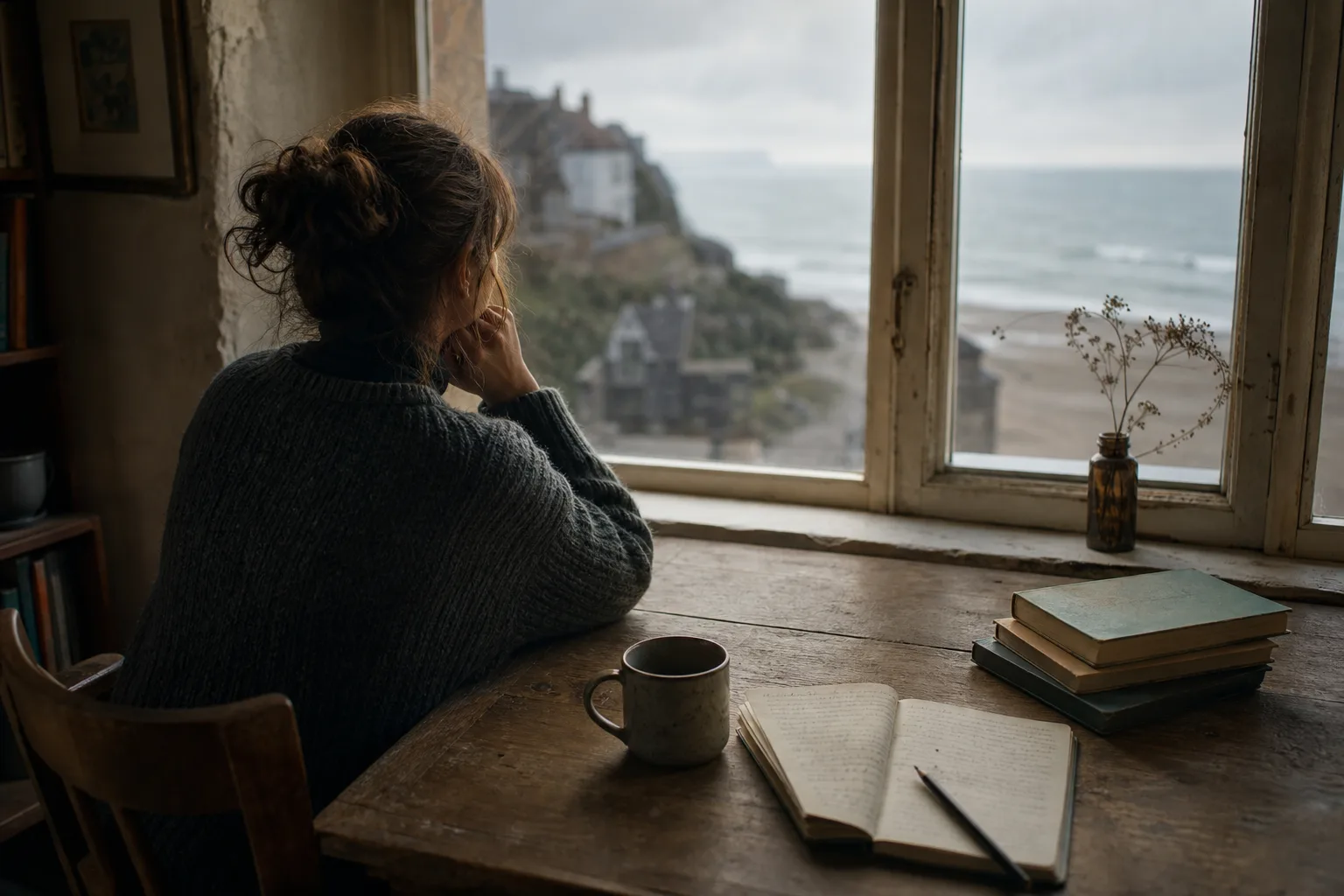
How do you write a place you remember when you can see only parts of it? Writing a place you remember starts with separating what returns clearly from what you are supplying to make the scene feel complete. The aim is not to reconstruct a perfect record. It is to make the remembered moment vivid while letting uncertainty remain visible.
How do I tell a memory from a guess?
Begin by writing down the details that arrive without prompting: a patch of cold on your hand, the scrape of a chair, a strip of light on the floor. Then mark anything you infer from habit or later knowledge. You may remember a room as dark without knowing which curtains were drawn, or remember rain without knowing whether it began before you arrived.
Use a simple notation while drafting: write “remember” beside details that feel directly recalled, “infer” beside likely explanations, and “unknown” beside gaps. These labels are for your working notes, not necessarily the finished scene. They stop a plausible detail from quietly becoming a claimed fact.
- Direct sensation: What sound, texture, smell, taste, temperature or colour comes back?
- Position: Where were you, and what could you actually see from there?
- Interpretation: What are you concluding now that you may not have known then?
- Uncertainty: Which part cannot be recovered, even after you pause?
Keep the distinction in your notes, even if the prose later moves more freely.
What sensory details should I trust?
Trust a sensory detail in proportion to how distinctly it returns, not because it seems typical of the place. A remembered smell of damp wool may be more reliable than a clear picture of the room’s layout. Memory often preserves a few strong impressions while leaving the surrounding arrangement indistinct.
Ask yourself how the detail appears in your mind. Does it arrive as a specific sensation, or does it feel like a reasonable addition because kitchens usually have tiled floors, school halls have notices, or seaside rooms contain sand? Familiarity can make an invented detail feel effortless. That ease is not evidence.
Make a short sensory inventory without trying to fill every sense. You might have a sound and a temperature, but no reliable smell or visual panorama. Leave those channels quiet. A scene can feel present through a few exact details and a clear point of attention.
Prefer a modest detail you can stand behind to a colourful one that only completes the picture.
How can I make an incomplete place vivid?
Anchor the scene in what the remembered self noticed, rather than describing the whole location as if from above. Choose a position: leaning by a doorway, sitting at a table, waiting beside a gate. Then let the scene extend only as far as that position permits.
Use a small number of details that work together. A humming light, a sleeve stuck to your wrist and the distant clatter of dishes can establish a room without specifying its dimensions or every object in it. The reader needs a felt point of view, not an architectural survey.
Imagine you remember waiting in a clinic corridor: the vinyl chair felt cool through your coat, a clock ticked unevenly, and a door opened somewhere down the hall. You do not remember the wall colour or the wording on the notices. You could write the chair, the tick and the opening door, then let the corridor remain visually spare; the expected effect is a scene centred on waiting rather than a falsely complete room.
Use movement to connect what you do remember. A glance shifts from the chair to the door; a sound draws attention away from the clock. This gives the reader a route through the scene without requiring you to invent a floor plan.
Should I write “I don’t remember” in the scene?
Sometimes. A direct admission is useful when the gap matters to the scene, such as when you are unsure what someone said or cannot recall how you left. It can also be more honest to leave the detail out and let the scene’s limits show through what you do include.
Choose the form that keeps attention on the moment. “I can’t recall what was written on the sign” may be worth keeping if the sign has become part of your later uncertainty. If it contributes nothing, omit it rather than pausing to explain every absent detail.
Avoid turning uncertainty into a repeated disclaimer. Constantly writing “perhaps”, “I think” and “maybe” can make a scene hesitant without making it more truthful. Place a clear qualification where it matters, then write the secure details plainly.
Make uncertainty visible at the point where it affects meaning, not in every sentence.
How do I write dialogue I cannot recall exactly?
Do not present reconstructed words as a precise quotation. If you remember the substance but not the wording, use indirect speech: you can say that your aunt asked you to stay, without inventing the sentence she used. If the sound or phrasing is genuinely clear, direct dialogue may be appropriate.
Another option is to describe the exchange through its effect: the question came softly, or the reply left the room quiet. Use such descriptions only if you remember that quality; do not substitute a familiar emotional cue for missing evidence. The aim is to preserve what the conversation did in the scene without claiming a transcript.
When the exact wording carries the whole scene, consider whether you can write about your present uncertainty instead. A remembered pause, a change in tone or your own response may be more dependable than a polished line of dialogue.
How do I handle conflicting memories or later information?
Separate what you remember from what you learned afterwards. A photograph, a relative’s account or a visit to the place now may help you understand the setting, but it does not automatically restore your original view of it. Keep those sources distinct in your notes.
If your memory conflicts with another account, you can state the limit plainly: you remember the room one way, while the photograph suggests something else. Do not quietly merge both into a seamless scene. A remembered impression can remain meaningful without being treated as a complete record.
Also distinguish the place as it was then from the place as it appears now. A rebuilt doorway or a changed street name may orient the reader, but it belongs to later knowledge. Include it only if that contrast matters to the piece.
Let later evidence clarify the boundary of a memory, not erase it.
How can I revise a memory scene without making it less honest?
Revise for clarity and shape, not for completeness. A scene may begin with a sensory detail, move towards a person or sound, and end at the point where your recollection thins. You can remove repeated explanations and still preserve uncertainty.
On a separate pass, inspect each concrete noun and confident statement. Ask whether you remember it, have a source for it, or have added it because the scene seemed to need it. Replace unsupported specifics with a broader truthful description, or cut them.
- Underline details you remember directly.
- Circle details supplied by later information.
- Put a question mark beside details that are guesses.
- Remove guesses that do not affect the scene.
- Qualify or omit guesses that shape the reader’s understanding.
- Read the scene aloud and check that each shift in attention is clear.
After revision, writing a place you remember should leave the reader with a definite experience and an honest edge around what cannot be recovered. The gaps do not need decorative explanations. Often, the strongest final detail is the one you can still feel clearly, followed by a clean stop.